Sunday, October 9, 2011

Wordle vs. WordSift

While reading the eVoc Strategies article,  "eVoc Strategy 1: Learn From Visual Displays of Word Relationships Within Text" stood out to me. In that section they talked about Wordle, which is a great tool for looking at the frequency and importance of words in given text. They also mentioned WordSift which has a similar concept to Wordle. While Wordle is cutamizable in shape, color, layout, etc., in WordSift "each word can be clicked on to show a collection of related images, a word map, and a listing of sentences from the text that present the word in different contexts." I wanted to see the differences for myself so I used the Preamble to the Constitution in each generator and this is what I got...

Wordle:
Wordle: We the People


WordSift:

While I love the creativity of Wordle, I really think that the word maps could be so beneficial to students. Wordle is definitely more well known, but which do you prefer?

Sunday, October 2, 2011

Learning to be Good Coaches

In her article, Clark notes that the teachers she talked to all believed that coaching "was critical to their success in helping children learn to read." She then discussed how she had her pre-teacher students practice coaching scenarios. I really enjoyed the fact that she had them brainstorm these possible reading situations they will encounter in the classroom. I am currently spending time each week in a 2nd grade classroom and I occasionally struggle to find the right words to coach the children, whether it be in reading, math, or otherwise. Sometimes I find myself telling a child to "sound it out" when there are coaching strategies that would work well in that situation. I think that having the opportunity to learn about and practice coaching strategies outside of the school setting is a great way to prepare to teach reading. Having lots of strategies under my belt will not only make me a more successful reading teacher, but having the practice will make me more confident in my coaching abilities.

Monday, September 26, 2011

Read Aloud Script

Here's an example of a script you could use with a classroom for a read aloud. There are so many resources online, so it is easy to find something to meet the needs of your classroom.

http://www.balancepublishing.com/Leaf%20Aloud%20Script%20example.pdf

Interest Affects Reading

Would you want to spend time reading something that you didn't find the least bit interesting? I know I wouldn't! While reading Deeney's article on fluency measures, I really honed in on the point she made about interesting text. Teacher's recomend books to children all the time, but if it doesn't interest the child they will not want to or enjoy reading it. Deeney says that, "For struggling readers, that something [that interests them] is often factual information. That means it is so important for classroom libraries to be filled with all types of books, not just fictional stories. "Having a variety of accessible texts (books, magazines, brochures, Internet), in terms of redability as well as availability, is critical for engaging students in reading.

Here are some examples of classroom libraries where teachers could provide different types of reading materials, separated out for easy access.


As adults, we choose to read things that we find interesting, so why don't we give children that same option?

Monday, September 19, 2011

Are We Qualified to Support Literacy Development?

        As I was reading the IRA/NAEYC position statement, I found it very interesting that there are no uniform licensure standards for teachers of young children. The article even stated that, "A high school diploma is the highest level of education required to be a child care teacher in most states." (NAEYC, p. 2) I would like to think that since 1998 when this position statement was adopted, standards have become more vigorous. As a pre-teacher in the CFS department at UT, I have already learned so much about the way that children develop and how they begin to read. It is my hope that I am learning the same things as other pre-teachers at UT, in this state, and across the country. I completely agree with the position statement that "A comprehensive, consistent system of early childhood professional preparation and ongoing professional development" is needed. (NAEYC, p. 10) I believe that every child deserves the best from their education, and having qualified and informed teachers and teachers aides is the way to achieve this.
         I know that we take the Praxis here in Tennesse before we can get our teachers license, but while looking around on the Praxis website I saw that some states require teachers to take that test and others require other tests. If all teachers are not tested on the same materials and theories, how can we guarantee that every teacher will have the best knowledge base for teaching literacy to young children?

Sunday, September 11, 2011

Environmental Print!

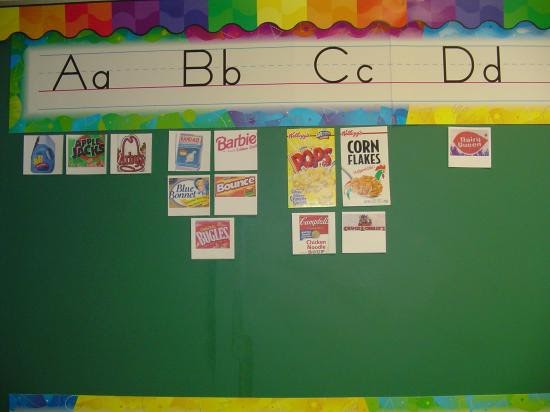
While Reading the Bell and Jarvis article, their use of environmental print really stood out to me. While children may not think they can read, they can read the print that is around them everywhere; environmental print. After reading Donna Bell's explination of how she created an alphabet banner that included environmental print and the children's names, I wanted to see how other teachers have incorporated environmental print into their classrooms of young readers. Here are some of the different ways that teachers have used it in the classroom.


Most of these are buletin board displays of environmental print, but there is also a book, and a pocket chart for building sentances. What types of ways will you incoprorate environmental print into your classrooms?